
How to Orchestrate a Melody: The Six Essential Approaches
This article explains how to orchestrate a melody by reducing orchestration to six fundamental approaches, helping composers make clearer and more deliberate decisions.
The Problem: Too Many Options
You have written an amazing melody and now you want to orchestrate it. The orchestra is so vast! What do you do?
For many composers, orchestrating a melody feels overwhelming precisely because there are so many apparent options.
But what if I told you there were only six ways to orchestrate a melody or countermelody?
“But I can think of six right now! A flute plays it, an oboe plays it, a violin, xylophone, or cello plays it. And that’s not even including the possibility of combinations of those instruments playing it together, like flute and violin, or xylophone and oboe. Or maybe even techniques like pizzicato cello doubling a bassoon.”
I would respond by saying: you’ve actually given me six instrument choices but just two different ways of orchestrating the melody.
How else could you use those instruments?, I ask.
You stumble for a moment, then another option emerges:
“I could put the flute and oboe in octaves, or maybe the violin and cellos?”
Fabulous. Now we have three ways of orchestrating our melody.
Anymore?
You’re stumped.
Because you haven’t picked up Alfred Blatter’s Instrumentation and Orchestration. Or maybe you did, and you just forgot. Either way, that doesn’t matter: I’m here now to tell you, or remind you Now.
- How to Orchestrate a Melody: The Six Essential Approaches
- The Problem: Too Many Options
- A Framework for Orchestrating a Melody
- The Six Ways (Starting With What You Spotted)
- Thinking Differently About Doubling
- Analysing Dvořák: The Golden Spinning Wheel
- Opening Gesture: Intervallic Doubling
- What do you hear?+
- Contrast Through Octave Doubling
- What do you hear?+
- Solo Lines and Intimacy
- What do you Hear?+
- The Weight of Similar Unisons
- What do you Hear?+
- The Subtle Synthesis of Different Unisons
- What do you Hear?+
- The Synthetic Potential of Octaves
- What do You Hear?+
- Conclusion: Thinking in Categories, Not Combinations
A Framework for Orchestrating a Melody
This article presents a simple framework, presented by Alfred Blatteer in Instrumentation and Orchestration, for how to orchestrate a melody by reducing the process to six fundamental approaches. Rather than thinking in terms of endless instrumental combinations, we will think in categories: a way of working that makes orchestration clearer, more deliberate, and potentially more expressive.
The Six Ways (Starting With What You Spotted)
1. The Solo Line: Orchestrating a Melody with One Instrument
Starting with your first response: “a flute, oboe, violin, xylophone or cello plays the musical line.”
What do you notice about these instruments? Some are similar, some quite different, but the consistency is that there is only one.
You have a single, solo player.
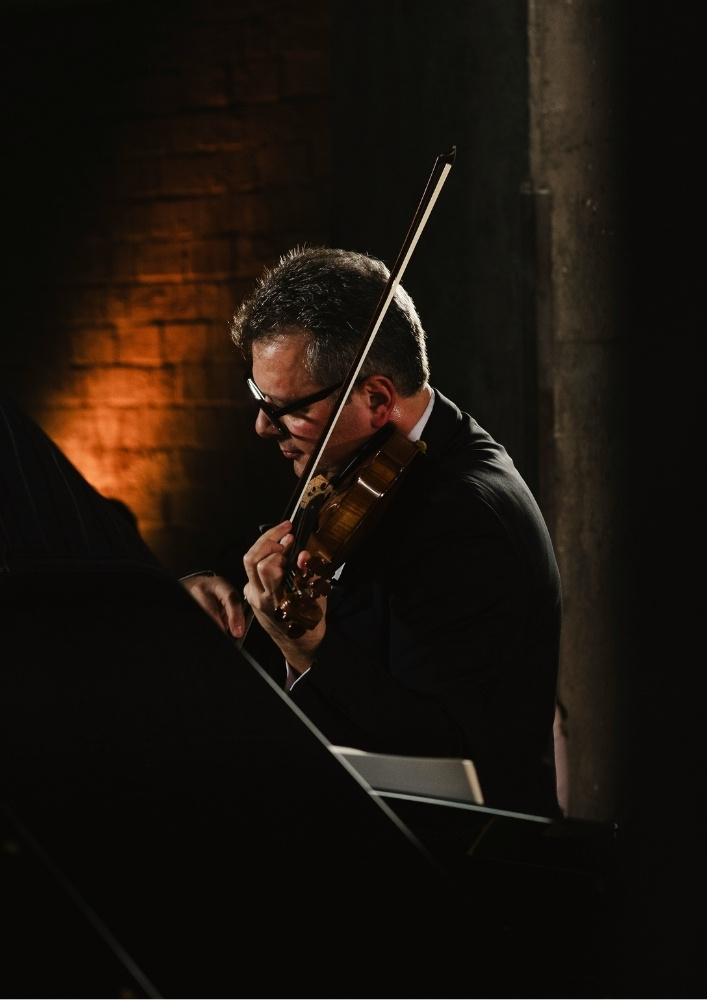
This is the first way of scoring your melody within the orchestra: giving it to a soloist.
The beauty of this approach is the intimacy and clarity of a single instrumental colour. There is no blending or balancing to worry about (other than balancing against the accompaniment or countermelody). Just the clean, clear sound of a flute, oboe, violin, xylophone, or cello.
Be careful not to swallow up a soloist with too much surrounding sound. Give them space.
2. Doubling Different Instruments at the Unison
The second technique you identified was doubling two or more different instruments at the unison.
Now we encounter challenges of balance, intonation, and blend. We lose a little clarity, but gain a new colour: a synthesis of sounds. We also gain weight and, potentially, richness.
Doubling different instruments at the unison provides a strong colouristic and weight contrast with the solo sound, without being as overtly present as octave doubling.
There is also the risk of overdoubling and creating a mass of turgid timbres. So, like with all these techniques, take care.
3. Doubling Different Instruments at the Octave
Another technique you spotted builds directly on the last: doubling instruments at one or more octaves.
This gives presence and, potentially, power to your melody. Balance challenges still exist, but they are often reduced, as each instrument can be placed in its most resonant register. There is also natural separation between the instruments: they occupy different parts of the sound spectrum.
So, that’s three ways of orchestrating a melody.
What else?
Thinking Differently About Doubling
From your examples (excluding the ones we have already explored), how else might we organise or think about these doublings?
Look at the pairs you suggested:
- flute and oboe
- flute and violin
- violin and cello
What do these have in common?
They are not the same instrument.
Perhaps we should pair the same instruments?
4. Doubling the Same Instrument at the Unison
So, what if we double the same instruments at the unison?
Two or three flutes.
Two, three, or a section of violins.
Two, three, or a section of cellos.
Two or three oboes.
Maybe we ask a pair of percussionists to play two xylophones together at the unison. Or maybe that’s just too outrageous? Either way, the point stands.

Doubling the same instrument at the unison sacrifices some of the sharpness and clarity of the solo sound. Expression may be reduced, but richness and amplitude (though not simply doubled) increase. Balance is generally manageable because the instruments are the same. But tuning becomes more critical, especially when moving from one player to two. With three or more, tuning often becomes less of an issue.
The sound gains body and weight, but loses some presence.
5. Doubling the Same Instrument at the Octave
What about doubling the same instruments at the octave?
Two flutes in octaves: or bass or alto flute with flute.
Cor anglais and oboe in octaves, and so on.
Balance can become an issue here, particularly in woodwinds of exactly the same type e.g. 2 standard flutes in octaves, where register differences are significant.
It was the registeral richness of the woodwinds that made Rimsky-Korsakov (Principles of Orchestration) dislike this form of doubling for them specifically. Much of what determines whether these doublings succeed lies in how woodwind instruments behave across their registers. I explore this in more detail in Five Ways of Understanding Woodwinds, where register, weight, and projection play a central role in orchestration decisions.
That said, the result can be striking: a richer, more sonorous sound below and a more brilliant one above. The two lines are identical but separated by the octave, giving crispness and presence.
That’s five.
6. The Sixth Way: Doubling at Other Intervals
So what is number six?
We have:
- solo lines
- doubling different instruments at the octave
- doubling different instruments at the unison
- doubling the same instruments at the octave
- doubling the same instruments at the unison
What remains?
Doubling at intervals other than the unison or octave.
This technique most commonly involves doubling at the third or sixth, though other approaches exist, including clever doublings that create synthetic instruments through the overtone series.
Doubling at thirds and sixths adds harmonic support and richness. Rimsky-Korsakov recommends using the same instruments for thirds, and adjacent instruments for sixths e.g. flute above oboe or clarinet. He recommends this for similar reasons we discussed in octave doublings of the same instrument: balance reasons related to register, particularly in woodwinds.
A famous example of this approach is Ravel’s Boléro, where instruments are doubled at varying intervals and dynamic levels to create entirely new, synthetic orchestral colours. This way of thinking (in terms of categories rather than endless combinations) is something I return to often, including in my analysis of Poulenc’s Les Biches, where orchestration choices shape character far more than melodic material alone.
Analysing Dvořák: The Golden Spinning Wheel
It is admittedly a little cheeky to say there are only six ways to orchestrate a line. Within each category lies a huge range of possibilities.
But by thinking in categories, we simplify our thinking without limiting our imagination. We move away from endless combinations and towards clearer conceptual control.
Let’s see how this works in practice by looking at one of my favourite pieces by Dvořák: The Golden Spinning Wheel. Read about the history and story further here.
In a typically grisly Czech ballad written by Karel Jaromír Erben, Dvořák musically depicts the meeting of a prince and the beautiful Dornička. Out hunting in the forest, the prince decides he wants to marry Dornička. Sending her home with valuable gifts, Dornička is murdered by her jealous stepmother and stepsister. Cutting off her hands and feet, stealing her clothes, the stepsister poses as Dornička. An old man discovers the body of Dornička and exposes the killers through the gift of a golden spinning wheel that sings a tale of the crime when spun by the false bride. The prince storms into the wood to find the real Dornička alive, having being revived by the old man. The murderers are exposed and punished.
Opening Gesture: Intervallic Doubling
Dvořák opens The Golden Spinning Wheel with a superb demonstration of the final category: doubling at intervals other than the unison or octave.
Take a listen. What do you hear?
Horns: two horns together, but neither at the unison nor the octave.
Looking more closely, the gap between the two horn parts widens in the lower register and closes to a third in the upper register. Sometimes called natural brass spacing, this approach partially replicates the sound world of natural brass instruments and their reliance on the harmonic series. And, if you have ever seen the overtone series: the intervals are wider near its beginning.
Dvořák continues to use this spacing even when the theme moves to other instruments, including the strings. The horns (and the spacing itself) evoke nobility, reflecting the Prince riding through the woodland on his hunt. Brass is inherently stately, hence its association with fanfares, power, majesty, heroism (and occasionally tyranny.)
Contrast Through Octave Doubling
To contrast this majestic melody, Dvořák introduces a second idea and orchestrates it differently.
Take a listen. What do you hear this time, at the forefront of the music?
Violins.
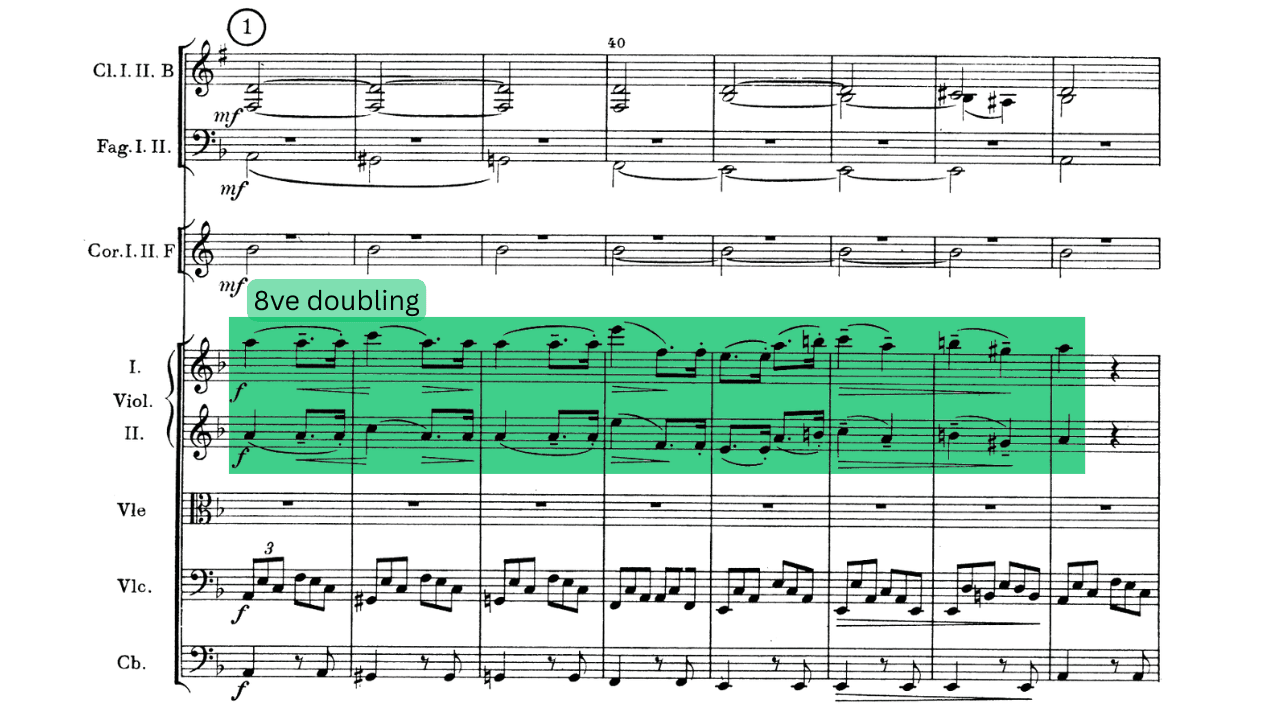
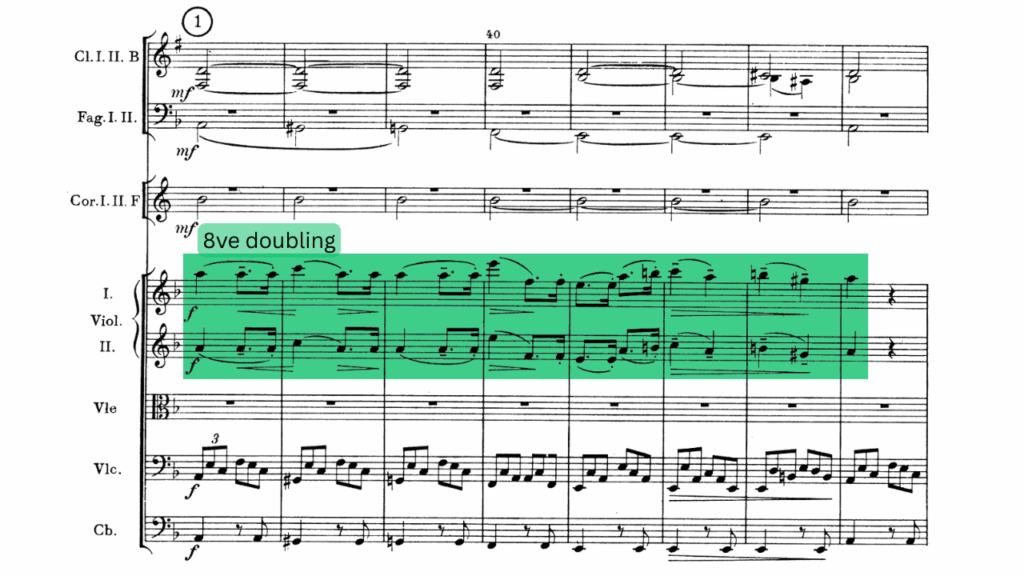
Although octave doublings can sometimes be subtle, here the melody is clearly orchestrated for first and second violins in octaves: first violins above, seconds below.
Octave doublings provide strength and presence. Plus, this being for sections of strings, with multiple players on each line, the sound gains mass and projection.
Solo Lines and Intimacy
Moving to the next thematic section, Dvořák introduces a pair of solo lines: one melody and one countermelody.
Take a listen. Can you identify the instruments that represent the prince’s love, Dornička?
One of the principal lines is played by a solo cor anglais, while the expressive melody is given to a solo violin.
The result is expressive yet restrained, reflecting a shift in the narrative focus: a moment of intimacy and modesty within the larger story.
Question: Why do you think Dornička is scored by solo instruments?
The Weight of Similar Unisons
As the work progresses, Dvořák moves into an Allegro section dominated by wind colours.
At first, we hear a solo oboe, followed by a solo flute. After a brief interjection from the strings, a pair of clarinets enters, playing a mischievous, oscillating figure. Then, two bassoons take up the Prince’s motif, playing it in thirds. We then return to the solo flute and solo oboe before the orchestration changes again.
This is a highly colourful section. The woodwinds narrate Dornička’s betrayal by her stepmother and stepsister. Crucially, the change in presence and clarity between solo lines and paired lines is palpable.
The clarinets carry slightly more weight, but the subtle, inevitable inflections of tuning soften their presence, pushing them marginally into the background. The bassoons, by contrast, gain a richness and warmth from their thirds — a density of sound that supports the dramatic weight of the moment.
The Subtle Synthesis of Different Unisons
In the piece’s middle section, Dvořák opens up his orchestral palette further by introducing more varied doublings.
There are four instrumentalists involved here: two flutes and two clarinets.
To my ear, the clarinets give the flutes more projection, making them (bizarrely but intriguingly) sound more flutey (technical term!). You may disagree; take another listen and see what you think.
At least at the unison, this effect holds. When the instruments break out into dyads, the clarinet timbre becomes far more apparent.
The Synthetic Potential of Octaves
Also in the piece’s middle section, Dvořák introduces another intriguing pairing. What do you hear?
The answer here is piccolo and oboe, with the piccolo sounding one octave above. To my ear, there is a clear separation between the two instruments (you can distinguish them individually) yet it also feels as though the prevailing sound of the oboe is being manipulated and amplified by the piccolo.
The piccolo appears to resonate with particular components of the oboe’s rich overtone structure, subtly altering how we perceive the oboe’s timbre as a whole.
Conclusion: Thinking in Categories, Not Combinations
So yes, it is a little cheeky to claim there are only six ways to orchestrate a melody but it is also an extremely practical way to think.
By thinking in categories rather than combinations, we dramatically simplify the orchestration process without reducing its expressive potential. Instead of being paralysed by the size of the orchestra, we begin by asking a much clearer question:
Am I hearing a solo, a unison, an octave, or an intervallic doubling? And if so, of what kind?
Once that decision is made, the orchestra becomes manageable. Instrument choice, register, balance, and colour follow more readily.
We can also develop contrast at the level of category. As a piece unfolds, a returning melody might be orchestrated in octaves where it was previously a solo. Likewise, if one section has been dominated by octave doublings, such as octave violins, a subsequent section might deliberately shift towards unisons or intervallic doublings. Simple at the category, the selection of instruments to fulfill this contrast is a process of refinement and nuance, not an unhinged and uneasy spontaneity.
What Dvořák demonstrates so clearly in The Golden Spinning Wheel is that orchestration is not about novelty or constant change. It is about controlling presence, weight, clarity, and synthesis over time. The same melody can feel noble, intimate, mischievous, or ominous simply by moving between these six fundamental approaches. A particularly clear example of this can be found in Vaughan Williams’s Dives and Lazarus, where string orchestration alone reshapes weight, intimacy, and breadth without relying on melodic transformation.
The next time you orchestrate a melody or countermelody, resist the temptation to ask which instrument should play it. Instead, ask:
- Do I want clarity or weight?
- Separation or synthesis?
- Intimacy or projection?
The answer will almost always place you in one of these six categories. From there, orchestration becomes less about guessing and more about listening.